
Oconee County Divorce Records and Case Lookup
Oconee County divorce records are filed and maintained at the Family Court in Walhalla, the county seat of Oconee County, South Carolina. The Clerk of Court keeps all case documents, from initial petitions to final decrees. Oconee County sits in the far northwestern corner of South Carolina, bordered by Georgia and North Carolina in the Blue Ridge foothills. The Family Court handles all divorce and domestic cases in the county as part of the 10th Judicial Circuit. This guide covers how to find, access, and understand Oconee County divorce records.
Oconee County Quick Facts
Oconee County Family Court
The Oconee County Family Court in Walhalla is part of South Carolina's 10th Judicial Circuit. It holds sole jurisdiction over divorce, separation, custody, support, and property division matters in the county. South Carolina's Family Court system was created in 1976 and applies uniformly across all 46 counties. The Clerk of Court is the official records custodian for all case filings. The courthouse is located on West Main Street in Walhalla, and the clerk's office is open on regular business days.
| Court | Oconee County Family Court 205 West Main Street, Walhalla, SC 29691 Phone: (864) 638-4280 |
|---|---|
| Hours | Monday through Friday, 8:30 AM to 5:00 PM |
| Website | oconeecounty.com |
The Oconee County Clerk of Court office can assist visitors with locating divorce case files, confirming whether a case exists, and providing certified or plain copies of documents. Staff cannot give legal advice, but they can direct you to the right forms and resources.
Below is an image from the Oconee County Clerk of Court page, which lists services, contact details, and filing information.
The clerk's page includes links to statewide court resources and information on requesting public records from the Family Court.
Note: The SC Family Court overview at sccourts.org explains how the court system is structured across all circuits.
How to Search Oconee County Divorce Records
The South Carolina Judicial Branch maintains a free public case search tool that covers Family Court records including divorces. Use the SC Courts case records search to look up cases by party name or case number. Results show filing dates, case status, and the parties involved.
Before you search, gather as much of the following information as you can:
- Full legal name of one or both parties to the divorce
- Approximate year the case was filed
- Case number, if available
- Whether the case was filed in Oconee County specifically
In-person searches are available at the Walhalla courthouse during business hours. Bring a valid photo ID. The clerk's staff can locate files, confirm case details, and process requests for document copies. If you are unsure whether a case was filed in Oconee or a neighboring county, the statewide online index is the fastest way to check without making the trip.
Below is an image from the Oconee County official portal, where residents can access county services online.

The portal links to the Clerk of Court, county departments, and online services available to Oconee County residents and the general public.
Divorce Filing Fees in Oconee County
The standard filing fee for a divorce action in Oconee County Family Court is approximately $150. This fee is set at the state level and applies across all of South Carolina's 46 counties. It covers the initial case filing with the clerk's office. Additional fees may apply for motions, amended filings, or service of process.
Copies of case documents cost a per-page fee. Certified copies are priced higher than plain copies because the clerk must officially authenticate each page. Certified decrees are often required by employers, banks, the Social Security Administration, and courts in other states. The clerk's office can give you a current copy fee schedule when you visit or call.
Fee waivers are available in Oconee County for those who cannot afford to pay. File an affidavit of indigency with the court, and a judge will review the request. Waiver forms are available on the SC Courts forms page. Approval is not guaranteed but is granted in genuine hardship cases.
Note: Always confirm fees directly with the Oconee County Clerk of Court before filing, since amounts can change.
Filing for Divorce in Oconee County
South Carolina law governs all aspects of divorce under SC Code § 20-3-10. The five recognized grounds are: adultery, desertion lasting at least one year, physical cruelty, habitual drunkenness or drug use, and continuous separation for at least one year. The separation ground is the most widely used in South Carolina and does not require either party to prove fault.
Before filing in Oconee County, at least one spouse must satisfy the residency rule under § 20-3-30. If both spouses live in South Carolina, either must have been a state resident for at least three months. When only one spouse is a resident, that spouse must have lived in South Carolina for at least one full year. Venue is proper in Oconee County if at least one party resides there at the time of filing under § 20-3-60.
After the complaint is filed and the other party is served, waiting periods begin under § 20-3-80. Two months must pass after service before a hearing can be scheduled. Uncontested cases require three months before a final decree can be entered. Property division in Oconee County follows equitable distribution under § 20-3-620, which means assets are divided fairly based on the circumstances of the marriage, not necessarily equally. Alimony is governed by § 20-3-130 and considers factors such as each spouse's income, the length of the marriage, and their contributions to the household.
What Oconee County Divorce Records Contain
A divorce case file in Oconee County can hold many types of documents depending on whether the case was contested and what issues were raised. Common documents in a typical file include:
- Summons and complaint for divorce
- Proof of service on the respondent
- Financial declarations and schedules
- Settlement agreement covering property and support
- Custody and visitation orders, if children are involved
- Final decree of divorce
- Any modification orders entered after the decree
The final decree is the document that officially ends the marriage. It is signed by the judge and entered into the permanent record. A certified copy of the decree is the document most people need for legal and administrative purposes. It confirms the date the divorce was granted and may set out the terms of the case. If children or significant property were part of the case, the file may be quite large and contain multiple orders.
Note: Since January 1, 2026, home addresses are no longer included in newly filed court documents under updated South Carolina privacy rules.
Divorce Certificates from the SC Department of Public Health
For a summary record of a divorce, the South Carolina Department of Public Health maintains an index of statewide divorce reports covering July 1962 through December 2023. These reports are not the same as court decrees. They confirm that a divorce was granted but do not include the legal terms or detailed case information found in the full court file.
Below is an image from the SC Courts courthouse search page, which is useful for locating the correct courthouse for any county in South Carolina.
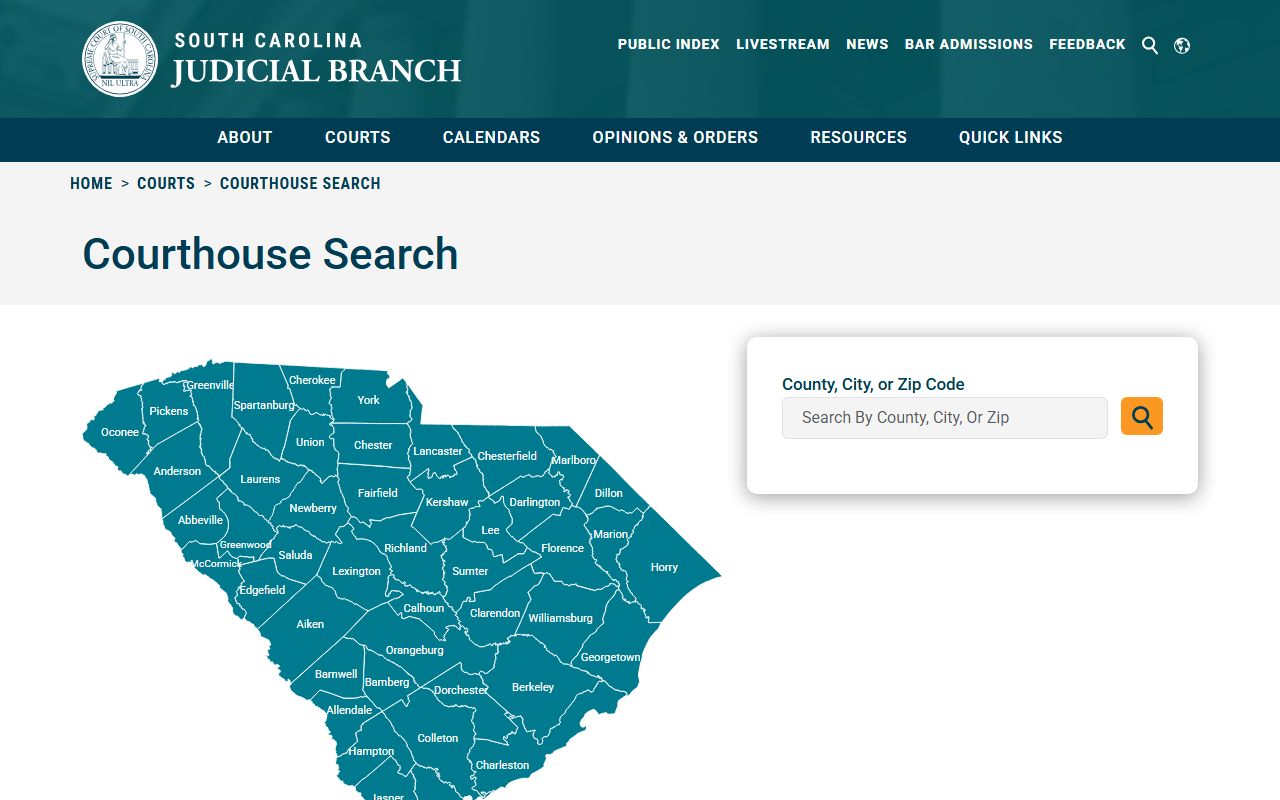
DPH divorce reports cost $12 each and can be ordered through the DPH vital records office or through VitalChek. For cases outside the DPH date range, or when the full court decree with legal terms is required, contact the Oconee County Clerk of Court in Walhalla. If a South Carolina divorce record needs to be used internationally, the Secretary of State's office handles apostille certification.
Public Access to Divorce Records
Oconee County divorce records are public records under SC Code § 30-4-10, which is South Carolina's Freedom of Information Act. Anyone may request access to a divorce case file at the Clerk of Court. You do not have to be a party to the case. Researchers, attorneys, journalists, and members of the general public all have the right to inspect most records.
Judges may seal specific documents or entire cases in limited situations, such as when minors are involved, domestic violence is present, or other sensitive circumstances apply. A sealed case is not available without a court order granting access. The clerk's office can tell you whether any part of a case has been sealed before you visit in person.
The statewide online index provides basic case information. Full document images are not always available digitally for older cases, so an in-person visit may be necessary. For historical or genealogy research, the Library of Congress South Carolina genealogy guide lists helpful resources for locating older vital records and court documents.
Legal Help for Oconee County Residents
Divorce cases can involve complex issues of property, debt, children, and support. If you need legal help but cannot afford a private attorney, free and reduced-cost services are available in South Carolina.
SC Legal Services provides civil legal assistance to eligible low-income residents, including help with Family Court matters in Oconee County. You can apply for services through their website or by calling their intake line. The South Carolina Bar also operates a referral service at (803) 799-6653, which can connect you with an attorney who handles divorce cases in the 10th Judicial Circuit.
If you plan to represent yourself, standardized Family Court forms are available at sccourts.org/court-forms. The Oconee County clerk's staff can help you identify which forms you need, but they cannot give legal advice. For those new to the process, getting at least one consultation with an attorney can prevent costly mistakes later.
Cities in Oconee County
All Oconee County divorce cases are filed at the Oconee County Family Court in Walhalla. Walhalla is the county seat where the courthouse is located, serving all residents of the county regardless of which city or town they live in.
Nearby Counties
Oconee County is in the far northwestern corner of South Carolina, bordered by Georgia and North Carolina. The nearest South Carolina counties for divorce record purposes are listed below.