
Greenville Divorce Records
Greenville is one of the fastest-growing cities in the Southeast, and its Family Court handles a high volume of divorce cases each year. All divorce filings for Greenville residents go through the Greenville County Family Court at 301 University Ridge. This guide explains where to search for records, what you can find, how to get certified copies, and what steps to take if you plan to file. Whether you need a record for legal purposes or personal research, the process is straightforward once you know where to start.
Greenville Quick Facts
Where to File in Greenville
All Greenville city residents file for divorce at the Greenville County Family Court. The court sits in the Greenville County Square complex in downtown Greenville. This is the same building that houses other county offices, making it easy to handle multiple tasks in one visit. The clerk's office accepts new filings and handles requests for copies of existing records.
| Court | Greenville County Family Court 301 University Ridge, Greenville, SC 29601 Phone: (864) 467-7140 |
|---|---|
| Hours | Monday through Friday, 8:30 AM to 5:00 PM |
| Website | greenvillecounty.org |
Greenville is part of the 13th Judicial Circuit. Judges assigned to this circuit rotate through Family Court, so the judge on your case may change during a long proceeding. The clerk's office staff can confirm current assignment schedules and let you know which courtroom to report to on your hearing date.
The City of Greenville itself does not handle divorce matters. All filings and record requests go directly to the county clerk.
Parking near the courthouse is available in the adjacent county garage off University Ridge. Street parking is limited during business hours.
The City of Greenville has grown significantly over the past decade, and court filing volume reflects that growth. Plan ahead for possible wait times at the clerk's window, especially early in the week.
Source: greenvillesc.gov
Note: Verify your county of residence before filing. If you recently moved from another South Carolina county, residency rules under § 20-3-60 may affect which court has venue over your case.
How to Search Greenville Divorce Records
South Carolina maintains a statewide case search tool through the Judicial Branch. The SC Judicial Branch public case search lets you look up cases by party name, case number, or attorney. Family Court cases in Greenville County are included in this portal. Search results show basic case information such as filing date, case type, and status.
For more detail, an in-person visit to the Greenville County Clerk of Court is often the most reliable approach. Staff can pull physical case files and confirm what documents are available for public review. Not all records are available online, particularly older cases filed before the court's digital systems were in place.
When searching, have the following ready:
- Full legal name of one or both parties
- Approximate year of the divorce or filing
- Case number, if known
- County of residence at the time of filing
Name changes from remarriage can complicate searches. Use the name on record at the time of the divorce. Court staff can help if you are unsure how the case was indexed.
Note: As of January 1, 2026, home addresses have been removed from public divorce records under updated South Carolina court rules. This applies to records requested after that date.
Filing for Divorce in Greenville
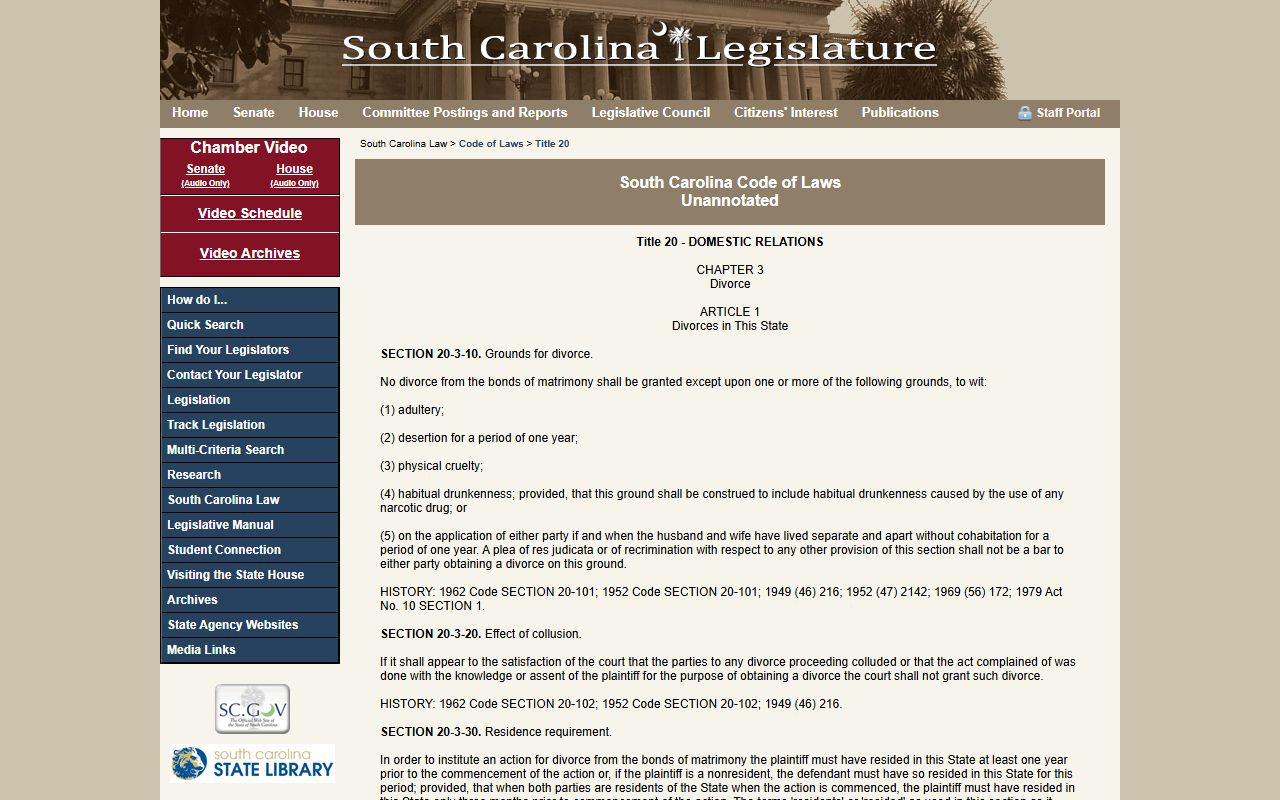
South Carolina law sets out specific grounds for divorce under § 20-3-10. The recognized grounds are adultery, desertion for one year, physical cruelty, habitual drunkenness, and living separate and apart for one year. The last ground — one-year separation — is the most common and does not require proving fault. Many Greenville residents use the no-fault separation ground to keep the process simpler.
Residency requirements are set by § 20-3-30. If both spouses live in South Carolina, one of them must have lived in the state for at least three months before filing. If only one spouse is a South Carolina resident, that person must have lived in the state for at least one year. Greenville residents who meet these requirements can file at the Greenville County Family Court.
When a divorce involves property, the court applies equitable distribution principles under § 20-3-620. South Carolina divides marital property in a fair but not necessarily equal way. The court looks at factors like the length of the marriage, each spouse's financial situation, and contributions to the marriage. Having a clear picture of all marital assets before filing makes this process go more smoothly.
Source: scstatehouse.gov
Note: Alimony may be awarded under § 20-3-130. The court considers factors including the marriage length, each party's earning capacity, and the standard of living during the marriage.
Fees for Greenville Divorce Records
Filing a divorce complaint in Greenville County costs approximately $150. This is the base filing fee paid to the Greenville County Clerk of Court at the time of initial filing. Additional fees may apply for motions, hearings, and other filings throughout the case. Fee schedules can change, so confirm the current amount with the clerk's office before your visit.
Copies of divorce decrees and other case documents typically cost a per-page fee set by the clerk. Certified copies carry an additional certification charge. Certified copies are often required for name changes, remarriage applications, insurance updates, and other official purposes.
If cost is a concern, South Carolina courts have a fee waiver process. You can ask the clerk for a waiver application, also called a poverty affidavit. Approval depends on your income and financial situation. The SC Judicial Branch court forms page has current waiver forms available for download.
Note: Payment methods accepted at the Greenville County Clerk of Court may include cash, check, and credit card. Call (864) 467-7140 to confirm accepted payment types before your visit.
What Greenville Divorce Records Contain
A divorce case file in Greenville County can include a range of documents. What is actually in the file depends on whether the divorce was contested or uncontested, and what issues were involved. Common documents found in divorce records include:
- Summons and complaint
- Answer and counterclaim, if contested
- Financial declarations and affidavits
- Temporary orders for support or custody
- Property settlement agreements
- Final decree of divorce
- Any orders related to alimony or child support
The final divorce decree is the most requested document. It contains the names of both parties, the date the divorce was granted, and the terms of the court's ruling. This is the document most often needed for legal and administrative purposes after a divorce.
South Carolina courts began keeping more detailed electronic records in recent decades. Older cases, especially those from before the 1980s, may exist only in paper form and require an in-person request. The SC Family Court page has general information on records access across the state.
Note: Certain records in cases involving minors may be sealed or restricted. Ask the clerk which portions of a file are available for public inspection.
Certified Divorce Certificates from the State
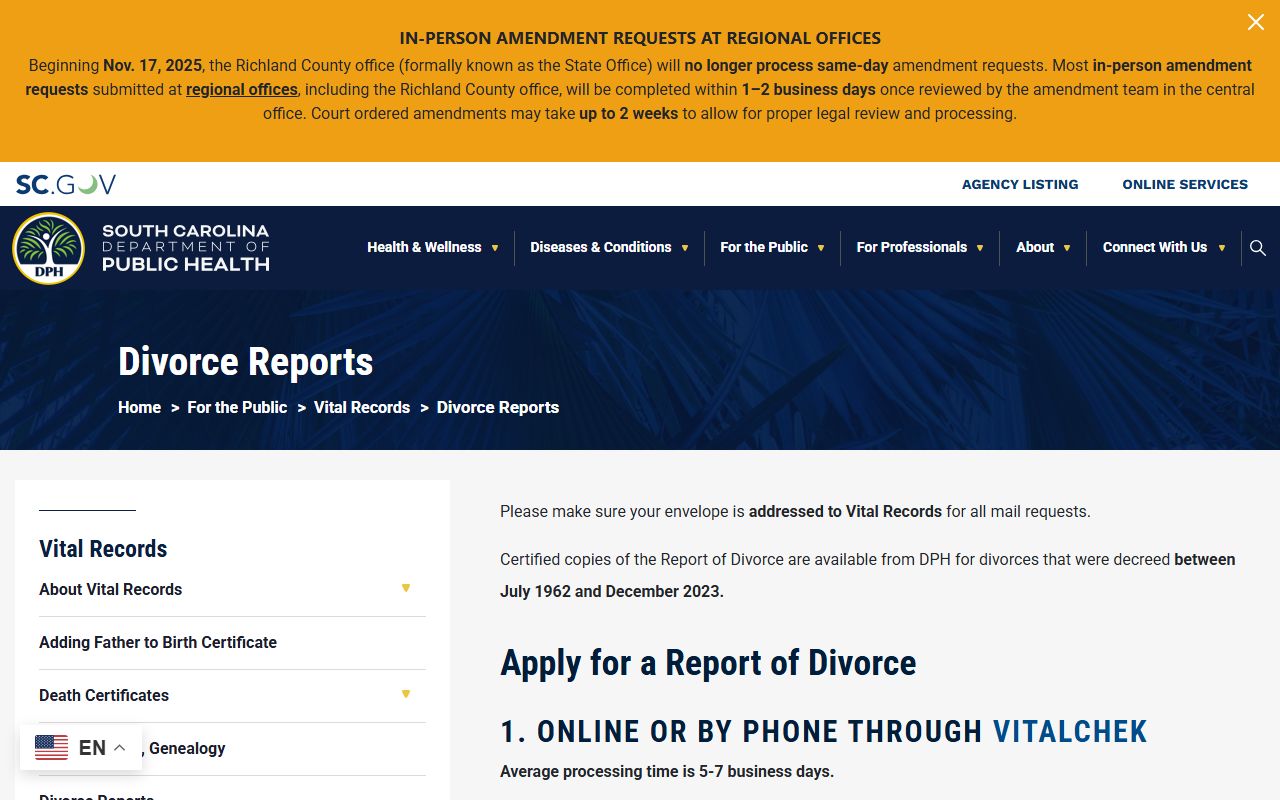
The South Carolina Department of Public Health issues certified divorce records for cases from July 1962 through December 2023. These are not the same as a full court file. A DPH divorce record is a summary document that confirms a divorce occurred. It shows the names of the parties, the county where the divorce was granted, and the date.
Source: dph.sc.gov
The fee for a DPH divorce record is $12 per copy. You can order records directly through the DPH vital records page or through the third-party ordering service VitalChek. VitalChek charges an additional service fee for online orders.
For divorces before July 1962, or for cases after December 2023, you will need to contact the Greenville County Family Court directly. The clerk's office can provide certified copies of the final decree and other case documents.
If you need a record certified for use in another country, the SC Secretary of State's office handles apostille certification for vital records. This is sometimes required for international legal and immigration matters.
Note: The SCCA299 form is used for divorce record requests submitted to the state. Check the DPH website for the current version of this form before submitting your request.
Legal Help for Greenville Residents
Divorce can be complicated, especially when property, children, or debt are involved. Greenville residents who need legal help but cannot afford an attorney have a few options. The SC Legal Services organization provides free civil legal help to low-income South Carolinians. Services vary by office and case type, but family law matters including divorce are often covered.
The South Carolina Bar runs a referral program that can connect you with a licensed attorney in the Greenville area. You can reach the SC Bar at (803) 799-6653. This line can help you find a lawyer who handles divorce cases, and many attorneys offer a free or low-cost initial consultation.
The Greenville County Bar Association may also have local referral resources. For those handling their own divorce without an attorney, the SC Judicial Branch offers self-help forms and instructions. These are available through the court forms page.
Note: Self-representation is allowed in South Carolina Family Court. However, court staff cannot give legal advice. They can only help with procedural questions about filings and court processes.
Self-Help Resources and Court Forms
The SC Judicial Branch provides downloadable forms for those who choose to handle their own divorce. These forms cover uncontested divorces, financial declarations, and related filings. They are available at no cost through the SC court forms page.
Greenville County Family Court also has self-help resources available at the courthouse. Ask at the clerk's window for information on what is available. Some counties in South Carolina have self-help centers staffed by volunteers or legal aid staff who can answer general questions. Check with the Greenville County courthouse to see what is currently offered.
For general information on how South Carolina Family Court works, visit the SC Family Court overview page. South Carolina established its Family Court system in 1976 as a separate court dedicated to family law matters including divorce, custody, and support.
Note: Instructions included with court forms are general guides. Every case is different. If your situation involves disputed assets, custody questions, or other complex issues, consider speaking with an attorney before filing.
Greenville County Divorce Records
Greenville County Family Court is the filing court for all Greenville city residents. The court maintains divorce case records going back decades. Requests for older records may require additional time for staff to retrieve physical files from storage. For current cases, the online case search portal is the fastest starting point.
The Greenville County Clerk of Court handles all public records requests for divorce cases. Contact the clerk's office at (864) 467-7140 to confirm what documents are available and what the current copy fees are.
Nearby South Carolina Cities
Greenville sits at the center of the Upstate region. Several nearby cities also have residents who file for divorce in Greenville or Spartanburg counties. If you are looking for records from a neighboring area, these city pages may help.