
Saluda County Divorce Records
Saluda County divorce records are filed and maintained at the Saluda County courthouse, home to the Clerk of Court and the Family Court for the 11th Judicial Circuit. With a population of around 21,000, Saluda is one of the smaller rural counties in South Carolina, located in the western part of the state. All divorce cases are handled at the single courthouse on East Church Street in the town of Saluda. Public records are available for review under state law. Searches can be done online through the SC Courts portal or in person at the Clerk's office. The process is the same as in larger counties, but the staff volume is smaller and wait times are typically short.
Saluda County Quick Facts
Saluda County Family Court
Saluda County's Family Court is part of the 11th Judicial Circuit and handles all divorce and family law matters for the county. South Carolina established the Family Court as its own division in 1976. Since then, every divorce case in Saluda County has been filed and decided here. The Clerk of Court keeps the official record of each case from first filing through the final order. Being a small, rural county, the courthouse handles a manageable volume of cases, and staff are generally accessible.
| Court | Saluda County Family Court 100 East Church Street, Saluda, SC 29138 Phone: (864) 445-3035 |
|---|---|
| Hours | Monday through Friday, 8:30 AM to 5:00 PM |
| Website | saludacounty.sc.gov |
The courthouse is on East Church Street in downtown Saluda. It is a compact county seat, and the courthouse is easy to locate. Staff at the Clerk's office can assist you with locating case files, requesting copies, and answering questions about the process for obtaining certified documents.
The image below is from the SC Courts courthouse directory.
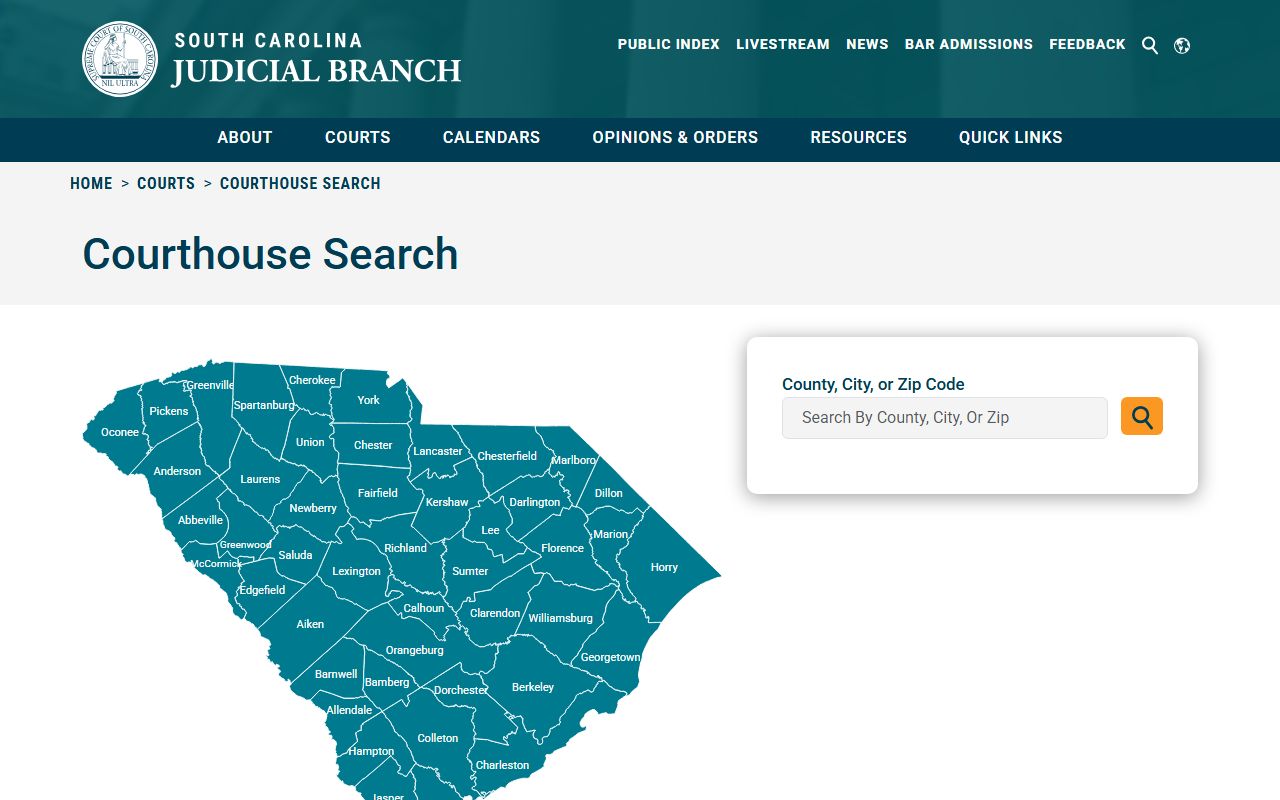
The SC Courts directory lists the courthouse address, phone, and clerk contact for Saluda County alongside all other South Carolina counties.
Note: Call ahead on days near a state holiday to confirm the office will be open and fully staffed.
How to Search Saluda County Divorce Records
Saluda County divorce records can be found through two main paths. The first is the South Carolina Courts online case records system, which covers all counties including Saluda. The second is a visit to the Clerk of Court office on East Church Street in Saluda. Both access the same official record. Online searches return case-level data. Full documents require a direct visit or a written request to the Clerk's office.
The SC Courts case records search lets anyone search by name or case number. Filter by Saluda County and the Family Court division for the most targeted results. The system shows filing dates, case status, and party names. Home address data was removed from online displays starting January 1, 2026, per a statewide policy change.
For an in-person visit, bring the following:
- Full legal name of one or both parties
- Approximate year of filing
- Case number if available
- A valid photo ID
- Payment for any copies or certified documents
The Clerk's office will pull the file and let you review it at a counter or terminal. Copies cost a per-page fee. Older records may not be digitized and could require extra time to locate. All Saluda County divorce cases are filed at the Saluda County Family Court — there is no other courthouse in the county.
Note: Online case data may not reflect the most recent updates. For current case status, call the Clerk's office directly.
Filing Fees and Copy Costs
The standard filing fee for a divorce in Saluda County is around $150, paid to the Clerk of Court when the petition is submitted. This fee opens the case and covers the initial administrative processing. If additional motions are filed during the course of the case, each may carry its own fee as set by South Carolina statute. The total cost can vary depending on how complex the case becomes.
Copies from a divorce case file are priced per page. Plain copies are less expensive than certified copies. A certified copy includes the official court seal and signature and is needed when the document must be used outside the court system — for example, when updating a name with a government agency or submitting proof of prior divorce to a court in another state. Fee waivers are available to filers who demonstrate financial need. A written request with income documentation must be submitted to the Clerk at the time of filing.
Note: Fee amounts are set by state law and can change. Verify the current fee schedule with the Saluda County Clerk of Court before your filing date.
The Divorce Filing Process in Saluda County
Starting a divorce in Saluda County requires meeting the state residency rule under South Carolina Code § 20-3-30. When both spouses live in South Carolina, either one can file after three months of in-state residency. When only one spouse lives here, that person must have been a resident for at least one year. Under § 20-3-60, venue may be in the county where either spouse resides, so residents of Saluda County can file here.
South Carolina recognizes five grounds for divorce under § 20-3-10. The five are adultery, willful desertion for one year, physical cruelty, habitual drunkenness or drug use, and living separate and apart for one year without cohabitation. The one-year separation ground requires no showing of fault and is the most widely used option across the state. After the petition is filed and served on the other party, § 20-3-80 sets a mandatory waiting period. Depending on the grounds, the minimum wait before a final hearing is two to three months.
Marital property is divided under § 20-3-620 using the equitable distribution standard. Equitable means fair but not necessarily equal. The court looks at how long the marriage lasted, what each spouse earned and contributed, and what each brought into the marriage. Alimony falls under § 20-3-130 and is separate from property division. A judge decides alimony based on the financial facts of the case, not as a default outcome.
The image below is from the SC Courts Family Court page.
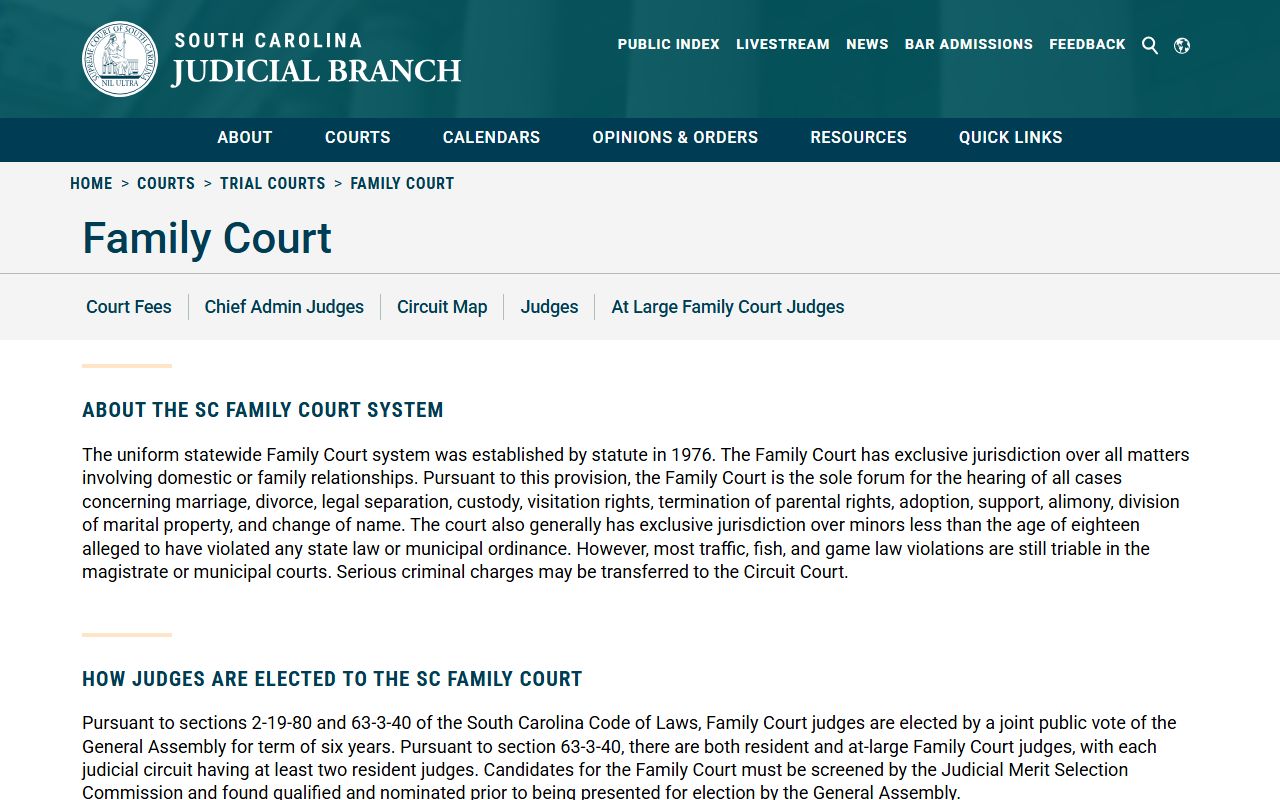
The SC Courts Family Court page explains the structure of the court, what it handles, and how to find your local courthouse.
Note: Filing requirements can be strict. Using the wrong form or skipping a required step can delay your case for weeks.
What Divorce Records Contain
A Saluda County divorce case file holds all documents generated during the course of the case. Simple uncontested cases are short. Contested cases or those involving children often contain more material and take longer to complete.
Typical documents found in a divorce case file include:
- Summons and petition filed by the requesting party
- Answer or response from the opposing party
- Any orders for temporary relief
- Financial declarations from both spouses
- Marital settlement or separation agreement
- Final divorce decree signed by a Family Court judge
- Post-decree motions if any were filed later
The final divorce decree is the most commonly requested document. It legally ends the marriage and lays out the terms of property division and any custody or support arrangements. You need this document for remarriage, name changes, and many benefit or insurance updates.
Note: Address data no longer appears in public court record displays as of January 1, 2026, in line with the statewide policy change.
Divorce Certificates from the SC Department of Public Health
The South Carolina Department of Public Health holds statewide divorce reports for cases finalized from July 1962 through December 2023. These reports are not the same as court records. They are a summary record that confirms a divorce took place, who the parties were, and when the divorce was final. A certified copy of a DPH divorce report costs $12. This document is often enough for administrative tasks that just need proof of a prior marriage being legally ended.
To request a report, visit the DPH vital records page or use VitalChek for online requests. You will need both parties' names and the approximate date and county of the divorce. A valid photo ID is required. Standard processing takes several weeks. Rush options may be available at additional cost.
When a South Carolina divorce record needs to be used abroad, the SC Secretary of State's apostille certification service handles authentication for international use.
The image below is from the SC DPH divorce reports page.
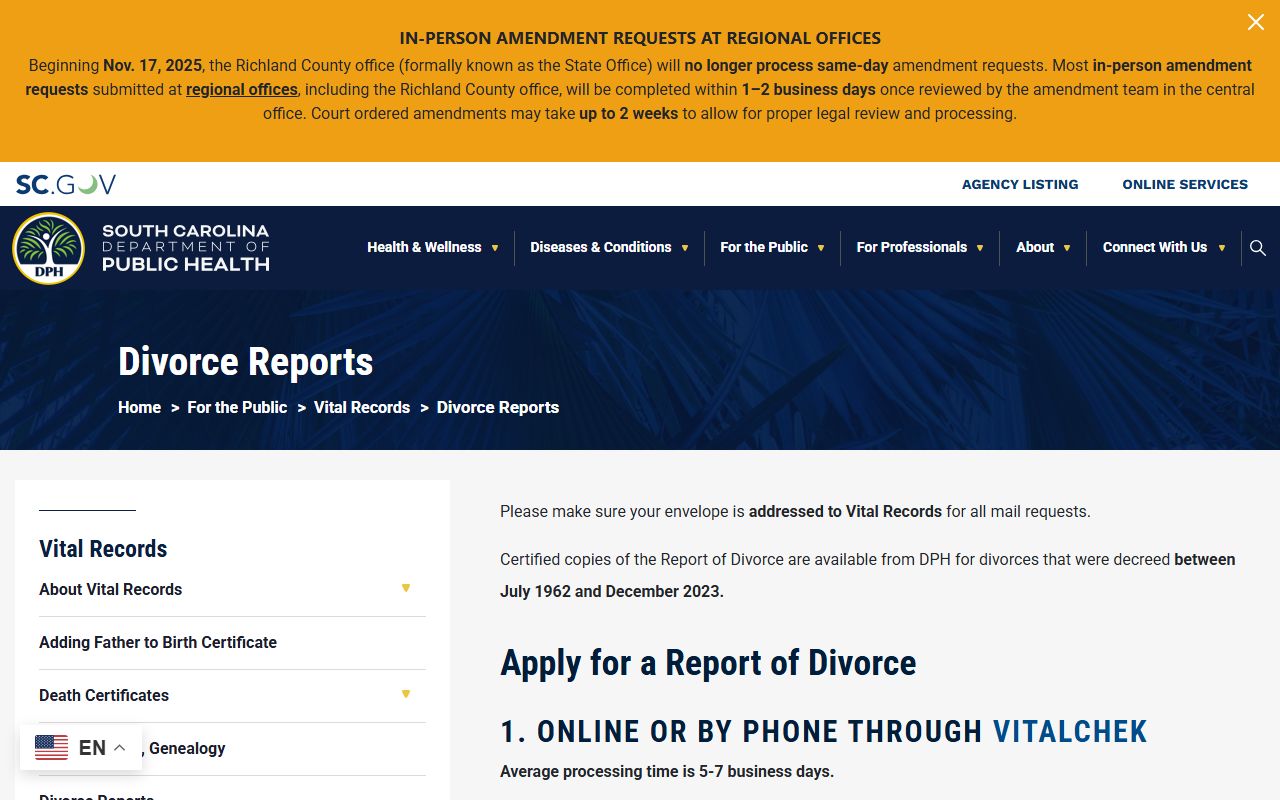
The DPH site explains what divorce reports include, how to order them, and what forms of ID are required for verification.
Note: DPH records end at December 2023. Divorces finalized after that date are only available directly from the Saluda County Clerk of Court.
Legal Help in Saluda County
Self-represented filers in Saluda County can use the standardized divorce forms available through the SC Courts forms page. The SCCA299 packet is designed for uncontested divorces and covers the basic filings required to open a case. The Clerk's office can direct you to the right packet but cannot give legal advice or help you fill out your forms.
SC Legal Services provides free civil legal assistance to qualifying residents in rural counties like Saluda. They handle divorce cases and can assist when the situation involves children, property disputes, or safety concerns. For a small county like Saluda, where private attorneys may be limited locally, SC Legal Services is often the most accessible option for low-income residents. Even a single phone consultation can help you understand the process before you walk into the courthouse.
Note: SC Legal Services eligibility depends on income and household size. Call or visit sclegal.org to check before your case date.
Public Access Under South Carolina Law
South Carolina's Freedom of Information Act at Title 30, Chapter 4 makes most court records open to the public. Saluda County Family Court divorce files can be reviewed at the courthouse unless a judge has sealed the case. Sealed records require a court order to access. Most divorce files are not sealed and are available to any person who visits during business hours.
Online access through the SC Courts Public Index shows case-level data for filed cases across the state, including Saluda County. Full document images are not always digitally available for older filings. Paper cases require an in-person visit. The SC Courts clerks of court directory has the current contact information for the Saluda County Clerk's office if you want to call ahead.
Genealogy and history researchers can use the Library of Congress South Carolina vital records guide for background on how and when divorce records began to be collected. Divorce was banned in South Carolina until April 1949, so no divorce records exist for the state before that year.
Note: Records in open or active cases may have restricted public access until the matter is fully resolved.
Cities in Saluda County
All Saluda County divorce cases are filed at the Saluda County Family Court. The county is rural, and the courthouse in the town of Saluda serves the entire county population.
Nearby Counties
Saluda County shares borders with several counties in western South Carolina. Each has its own Family Court and Clerk of Court for divorce filings and record access.