
Marion County Divorce Records Access
Marion County divorce records are filed and kept by the Clerk of Court in the city of Marion, the county seat of this rural Pee Dee region county in northeastern South Carolina. The Family Court handles all divorce and domestic relations cases for Marion County residents, and the Clerk of Court maintains the official record of every case from filing through final decree. If you need to search for a Marion County divorce record, obtain a certified copy of a court order, or learn about the filing process, the Clerk of Court at 100 Court Street is the right place to start, alongside the SC Judicial Branch online case records tool.
Marion County Quick Facts
Marion County Family Court
The Marion County Family Court is part of South Carolina's 12th Judicial Circuit and holds exclusive jurisdiction over all divorce, custody, support, and domestic matters for county residents. South Carolina created its statewide Family Court system in 1976, placing all domestic relations cases under one specialized court division. Before that time, divorce cases were handled in a less uniform way across the state's various courts. Today every divorce filed by a Marion County resident goes through this court.
The Clerk of Court at 100 Court Street in Marion manages the official record for every case. Staff there can search the local case index, pull files for in-person review, and process requests for certified copies of divorce decrees and other case documents. For general contact information and county office listings, the Marion County government website provides updated details for courthouse departments.
| Court | Marion County Family Court 100 Court Street, Marion, SC 29571 Phone: (843) 423-8240 |
|---|---|
| Hours | Monday through Friday, 8:30 AM to 5:00 PM |
| Website | marionsc.org |
The SC Judicial Branch clerk of court directory lists current contact details for the Marion County Clerk of Court alongside all other counties in the state.
The Marion County courthouse on Court Street serves as the central point for all Family Court filings and record requests in the county. The county's official site offers direct links to the Clerk of Court and related offices.
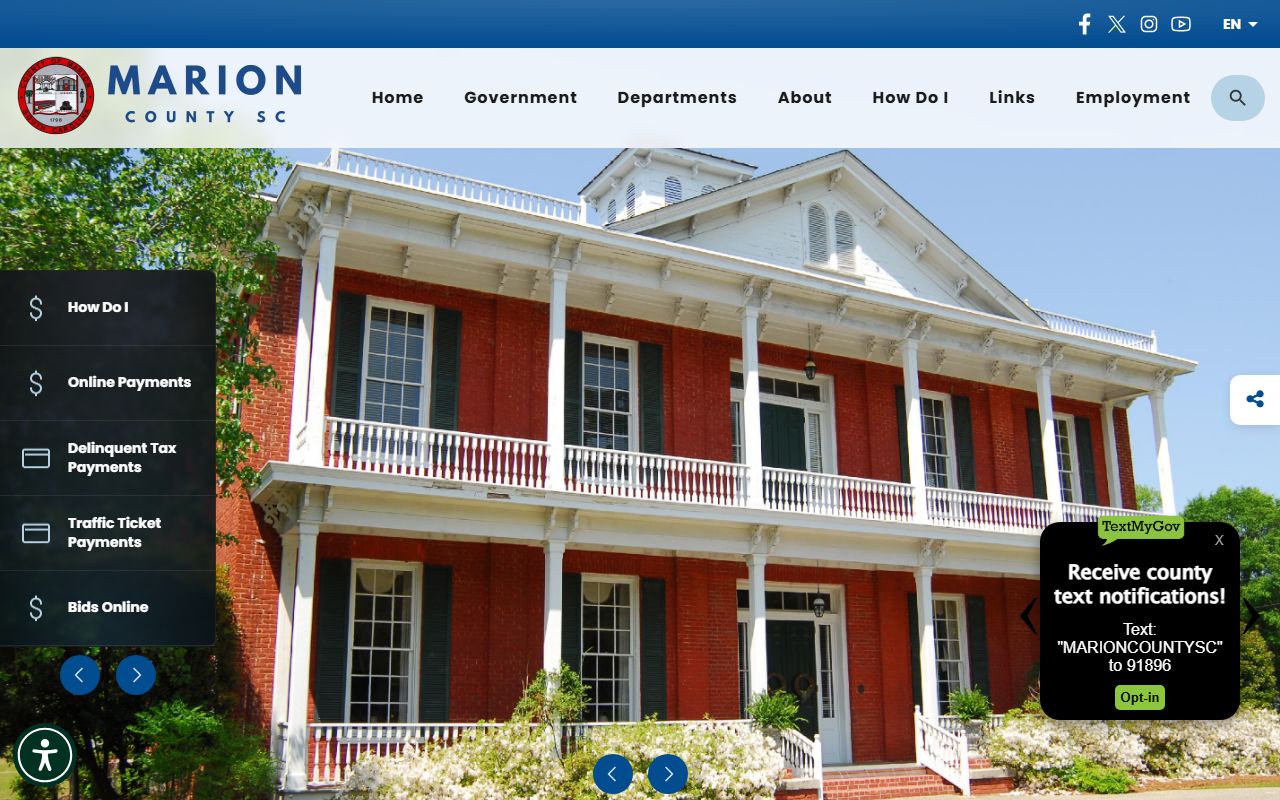
The Marion County portal includes office contact information, courthouse hours, and guidance on reaching the Clerk of Court for records requests.
Note: Marion County is a rural community, so the courthouse staff is relatively small, and calling ahead before an in-person visit can save time and help ensure the right staff member is available to assist you.
Searching for Marion County Divorce Records
The free SC Judicial Branch case records search is the best starting point for most record searches. This statewide online tool covers Family Court cases in all 46 counties, including Marion. You can search by party name, case number, or approximate date range. The tool returns basic case details and a docket showing filed documents and hearing dates. Many cases from recent decades are indexed online, though some older paper records may require an in-person visit to the courthouse.
For records not found in the online system, the Clerk of Court in Marion can conduct a local search and retrieve physical case files. In-person searches are especially effective for older cases, cases with unusual spelling variations in party names, or sealed files where the online entry may be limited. When visiting the Clerk of Court, bring as much identifying information as possible about the case.
Useful information to gather before searching Marion County divorce records includes:
- Full legal names of both parties as they appeared at the time of filing
- Approximate year or range of years for the divorce
- Case number if you have it from a prior document
- Any alternate name spellings that may have been used
Note: Home addresses were removed from the public Family Court case index as of January 1, 2026, so searches on recently filed cases will not display residential address information.
Marion County Divorce Record Access Under FOIA
South Carolina's Freedom of Information Act at SC Code § 30-4-10 establishes the public's right to inspect and copy government records. Family Court divorce records in Marion County are government records subject to this law. That means most documents in a finished divorce case are open for public review. Anyone can go to the Clerk of Court, request a case file, and examine its contents or request copies.
Some parts of a case file may be restricted. Records involving the welfare of minor children, documents sealed by court order, and materials containing confidential health or safety information may have limited public access. The Clerk of Court can identify what is available in a specific file and process copy requests for the portions that are open. The clerk's staff is familiar with these rules and can guide you through what is accessible in any given case.
The SC Judicial Branch courthouse directory helps confirm the current address, hours, and phone number for the Marion County location if you need to plan a visit or make a written request.
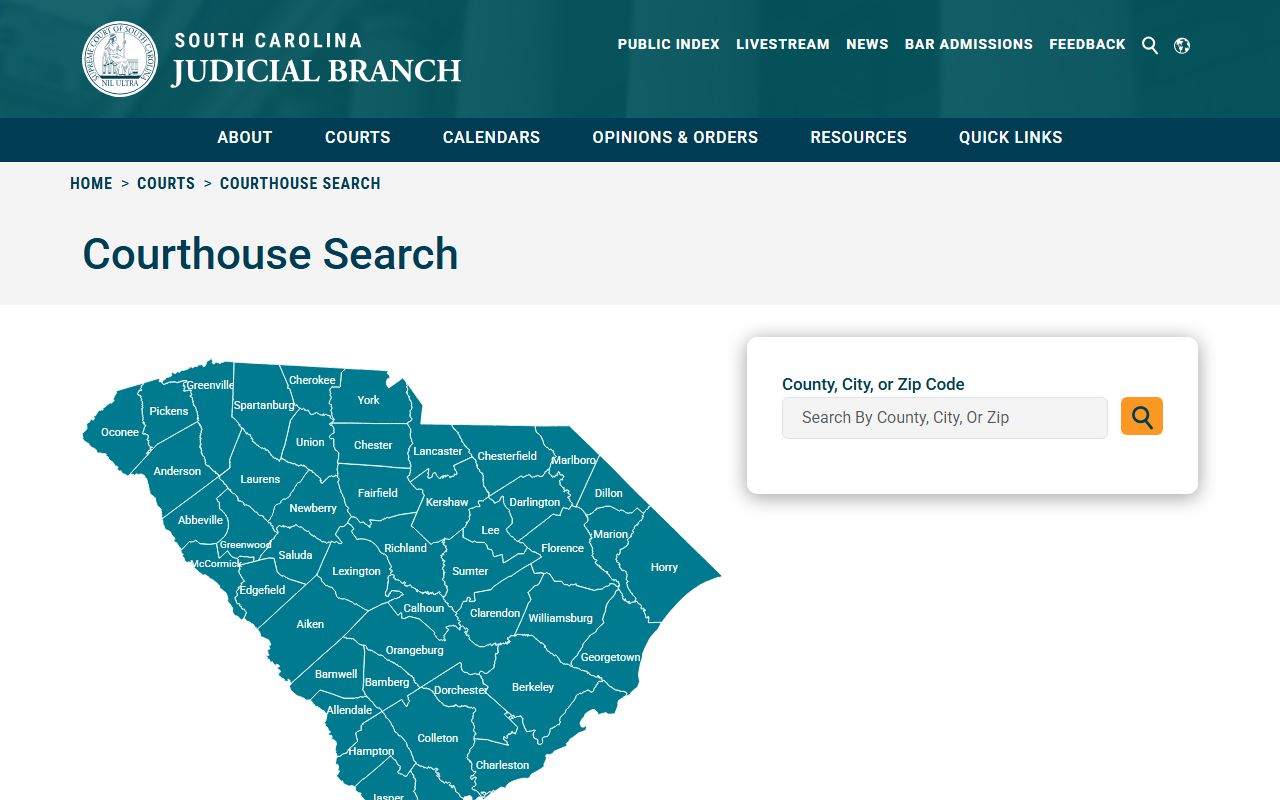
The SC courts site provides current information on Marion County court locations and links to the public case records search tool.
How to File a Divorce in Marion County
Filing for divorce in Marion County starts with confirming that you meet South Carolina's residency requirement. Under SC Code § 20-3-30, if one spouse lives in South Carolina and the other does not, the South Carolina resident must have lived here for at least one full year before filing. If both spouses are South Carolina residents, only three months of residency is required. These are strict thresholds, and filing before meeting the requirement can result in the case being dismissed.
South Carolina law under § 20-3-10 allows divorce on five grounds: adultery, willful desertion for at least one year, physical cruelty, habitual drunkenness or drug use, and separation for one continuous year without cohabitation. The one-year separation ground is the no-fault option and is the most common basis for divorce in Marion County. It requires no finding of fault by either party, simply proof that the spouses have lived apart continuously for a year.
Where to file is set by § 20-3-60. The case should be filed in the county where the defendant resides. If the defendant lives outside South Carolina, the plaintiff may file in their own county. For Marion County residents where both spouses live locally, the case goes directly to the Marion County Family Court on Court Street.
After filing, South Carolina imposes a mandatory waiting period: no case can be referred to a judge before two months from the filing date, and no final divorce decree can be issued before three months have passed. This is a firm rule under state law that applies to every divorce regardless of how simple it is. For property division, § 20-3-620 requires the court to divide marital assets in an equitable way, considering factors like the length of the marriage, each spouse's contributions, and each person's economic situation going forward. The SC court forms page has all standard forms including the Final Order SCCA299.
What Is in a Marion County Divorce File
A divorce case file at the Marion County Clerk of Court contains every document submitted during the course of the proceeding. The specific contents vary depending on whether the case was contested or uncontested, and whether children or significant property were involved.
Most Marion County divorce files include these types of documents:
- Summons and complaint setting out grounds and requested relief
- Return of service or acknowledgment of service by the other party
- Financial declarations showing income, expenses, and assets
- Any temporary orders for support or custody issued before the final decree
- A separation or settlement agreement if the parties agreed on terms
- The signed Final Order of Divorce (SCCA299)
The Final Order is the key document people most often need. It shows both parties' names, the case number, the date the court granted the divorce, and the judge's signature. The clerk's office can issue a certified copy of this order bearing the court seal. Certified copies carry legal weight and are accepted by government agencies, insurers, and other institutions as proof that the divorce was finalized.
Longer, more complicated cases may also include hearing transcripts, written orders on specific contested issues, expert reports related to property valuation, or documents related to alimony under § 20-3-130, which recognizes six types of spousal support in South Carolina.
Divorce Certificates and DPH Reports
There are two distinct sources for official documentation of a Marion County divorce. One is the Clerk of Court, which holds the actual court file and issues certified copies of the divorce decree. The other is the South Carolina Department of Public Health, which maintains statistical divorce reports compiled from records submitted by the courts.
DPH divorce reports are available for divorces granted between July 1962 and December 2023. These are not full court orders but summary records showing that a divorce occurred, and they cost $12 per certified copy. Orders can be placed directly with DPH or through VitalChek. For divorces granted before July 1962 or after December 2023, or when you specifically need the actual signed court order, contact the Marion County Clerk of Court instead.
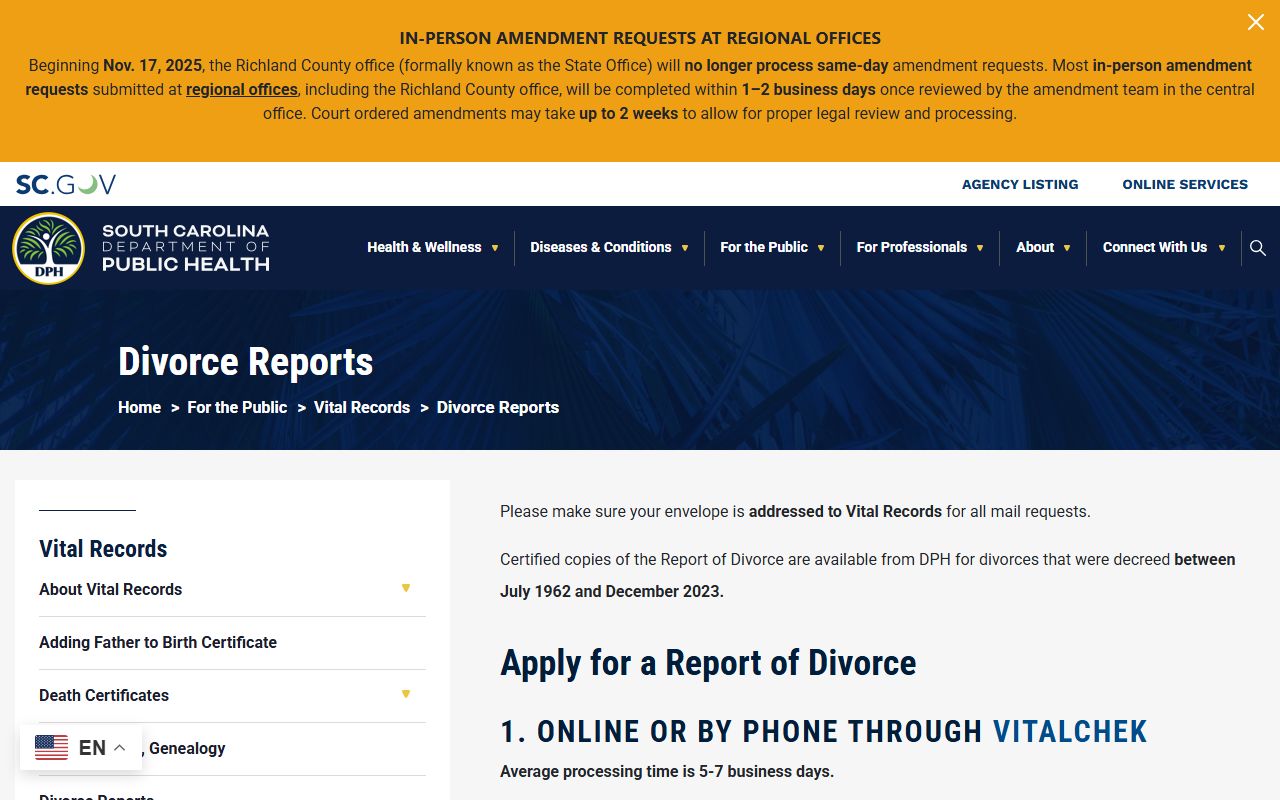
The DPH vital records page explains eligibility, fees, and ordering options for certified divorce reports from counties across South Carolina including Marion.
It is worth knowing that divorce was not legal in South Carolina until April 1949. Records for marriages that ended before that date will not be found in court divorce records, as residents at that time had to dissolve marriages through other means or relocate to another state to obtain a divorce.
If you need a certified copy authenticated for use in another country, the SC Secretary of State apostille service handles that process for South Carolina court and vital records documents.
Marion County Divorce Fees
Filing for divorce in Marion County costs approximately $150, which covers the initial summons and complaint. This figure is in the standard range for Family Court filings across South Carolina. Additional filings during a contested case, such as motions for temporary relief or hearings on specific issues, carry their own fees. The Clerk of Court's office can provide the current fee schedule.
Certified copies of documents from a divorce file cost a per-page fee plus a certification charge. The exact rates are set by state statute and are consistent across counties. If you need a copy of the Final Order or other documents, ask the clerk's staff for the current per-page cost when you contact them.
People who cannot afford court fees may request a fee waiver. The court reviews these requests individually. The SC Legal Services organization provides free legal help to income-qualifying residents and can assist with the fee waiver process along with broader guidance on divorce in South Carolina.
Legal Help for Marion County Residents
Marion County residents dealing with a divorce have several paths to legal help. The SC Legal Services website offers free civil legal assistance to residents who qualify based on income. Family law cases, including divorce, are among the areas they cover. Their site has self-help resources and an online application for assistance.
The SC Bar Lawyer Referral Service at (803) 799-6653 is available to anyone who wants to speak with a licensed family law attorney. The referral service connects callers with an attorney for an initial consultation. Lawyers connected through this service practice in family courts across South Carolina, including Marion County.
For those handling an uncontested matter without legal representation, the SC court forms library provides all standard Family Court forms with written instructions. These include the divorce complaint, financial declaration forms, and the Final Order SCCA299. The SC Family Court information page explains how the court works and what to expect at different stages of a case.
Note: Court staff cannot give legal advice on how the law applies to your specific situation, so consulting an attorney is the best step if you have questions beyond basic procedural matters.
Cities in Marion County
All Marion County divorce cases are filed at the Marion County Family Court. There are no separate city-level Family Courts for domestic matters in this county. Whether you live in the city of Marion or in any other part of the county, your divorce case is handled by the Clerk of Court at 100 Court Street in Marion.
Nearby Counties
Marion County borders several other Pee Dee region counties. If you are not sure which county a divorce was filed in, or if the parties lived near a county line, it may be worth checking neighboring county courts as well.