
Columbia, SC Divorce Records
Columbia is South Carolina's state capital and the seat of Richland County. Divorce records for Columbia residents are filed and maintained at the Richland County Family Court. The court keeps case files, final decrees, and related documents. Columbia is home to many state government offices, making it a central hub for public records access across South Carolina. Residents can search records online, visit the courthouse in person, or request copies by mail. All divorces in Columbia go through the county court system, not any city-level court.
Columbia Quick Facts
Where to File for Divorce in Columbia
Columbia residents file for divorce at the Richland County Family Court. The court is located in downtown Columbia and handles all family law matters for the county. Columbia Municipal Court deals only with city ordinance violations. It has no role in divorce cases. The Family Court clerk accepts new filings, processes paperwork, and stores all case records.
The City of Columbia does not maintain divorce records. All filings are court records held by the Richland County Clerk of Court. You must go to the county courthouse or use the online case search portal to find them.
| Court | Richland County Family Court 1701 Main Street, Columbia, SC 29201 Phone: (803) 576-1999 |
|---|---|
| Hours | Monday through Friday, 8:30 AM to 5:00 PM |
| Website | richlandcountysc.gov |
The Richland County Family Court serves all of Richland County, which has a population of roughly 420,000. Columbia, as the county seat, is where the courthouse sits. Both city residents and suburban residents use the same court for divorce filings.
The image below shows the South Carolina DPH divorce report portal, one source used to verify historical divorce data in Richland County.
Source: SC Department of Public Health — Divorce Reports
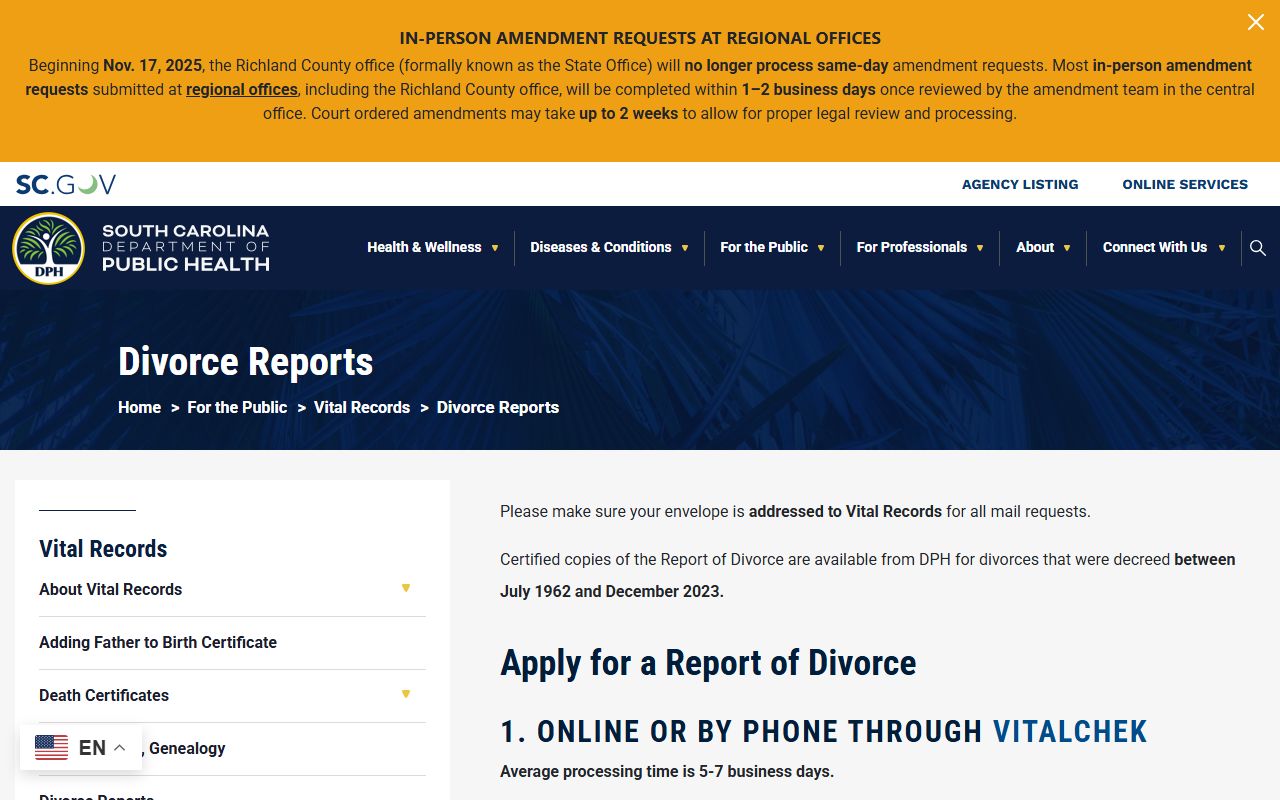
The DPH maintains records of divorces finalized in South Carolina from July 1962 through December 2023. These reports are useful for confirming that a divorce took place in Richland County during that period.
Note: Columbia Municipal Court handles only traffic and ordinance matters. If you are searching for a divorce case, you will not find it there.
How to Search Columbia Divorce Records
The SC Judicial Branch public case search is the most direct way to find divorce case records online. The search covers Family Court cases across all South Carolina counties, including Richland. You can look up cases by name or case number at no cost. Results show case status, filing dates, and hearing information.
To search in person, visit the Richland County Clerk of Court at 1701 Main Street. Clerks can help you locate case files and print documents for a small fee. Bring as much information as you can before your visit.
Useful information to have when searching:
- Full legal name of either party at the time of the divorce
- Approximate year the case was filed or finalized
- Case number, if known
- County where the divorce was filed
Online searches do not always show the full court file. Some older records may only be available in person at the courthouse. Sealed records require a court order to access.
Note: As of January 1, 2026, addresses have been removed from publicly available court records in South Carolina under updated privacy rules.
Filing for Divorce in Columbia
To file for divorce in Columbia, at least one spouse must meet the residency requirement under South Carolina Code § 20-3-30. If both spouses live in South Carolina, either one can file, but they must have lived in the state for at least one year. If only one spouse lives in South Carolina, that spouse must have been a resident for at least one year before filing.
South Carolina law recognizes five grounds for divorce under § 20-3-10. These are adultery, desertion for at least one year, physical cruelty, habitual drunkenness, and living separately for at least one year. The one-year separation ground is by far the most common in Richland County cases. It requires no fault and no accusation, which makes the process simpler for most couples.
After filing, the court generally imposes a waiting period. For cases involving children, the waiting period is three months. For cases without children, the waiting period is often shorter but still subject to the judge's schedule. The case cannot be finalized before this period ends.
Property division in South Carolina follows equitable distribution under § 20-3-620. This means the court divides marital property fairly, but not always equally. Both spouses must disclose their assets and debts. The court may also consider alimony under § 20-3-130, depending on the length of the marriage and each spouse's financial situation.
Richland County Family Court forms are available at sccourts.org/court-forms/. Filing packets for uncontested divorces are included.
Divorce Filing Fees in Columbia
The filing fee for a divorce in Richland County Family Court is approximately $150. This is a standard fee across most South Carolina counties. Additional fees apply for certified copies of the final decree, typically $1 to $3 per page. Service of process fees may also apply if the other party must be formally served.
Fee waivers are available for those who qualify. To apply, you must submit a financial affidavit showing that you cannot afford the filing costs. The Clerk of Court can provide the correct form. If the court grants the waiver, your filing fees are covered.
Note: Fees can change. Call the Richland County Clerk at (803) 576-1999 to confirm current amounts before you file.
What Columbia Divorce Records Contain
A divorce case file at the Richland County Family Court can contain many different documents. The contents vary depending on how the case was handled and how complex it was.
Common documents found in a divorce file include:
- Summons and complaint for divorce
- Proof of service on the other party
- Financial declarations and asset disclosure forms
- Temporary orders for support or custody
- Marital settlement agreement, if the case was uncontested
- Hearing transcripts or minute entries
- Final decree of divorce
Not all files contain every document type. Some older files may be incomplete. The final decree is the most commonly requested item and is usually available for a small copy fee.
The image below shows the SC Judicial Branch public records portal used to access Family Court case records statewide.
Source: SC Judicial Branch
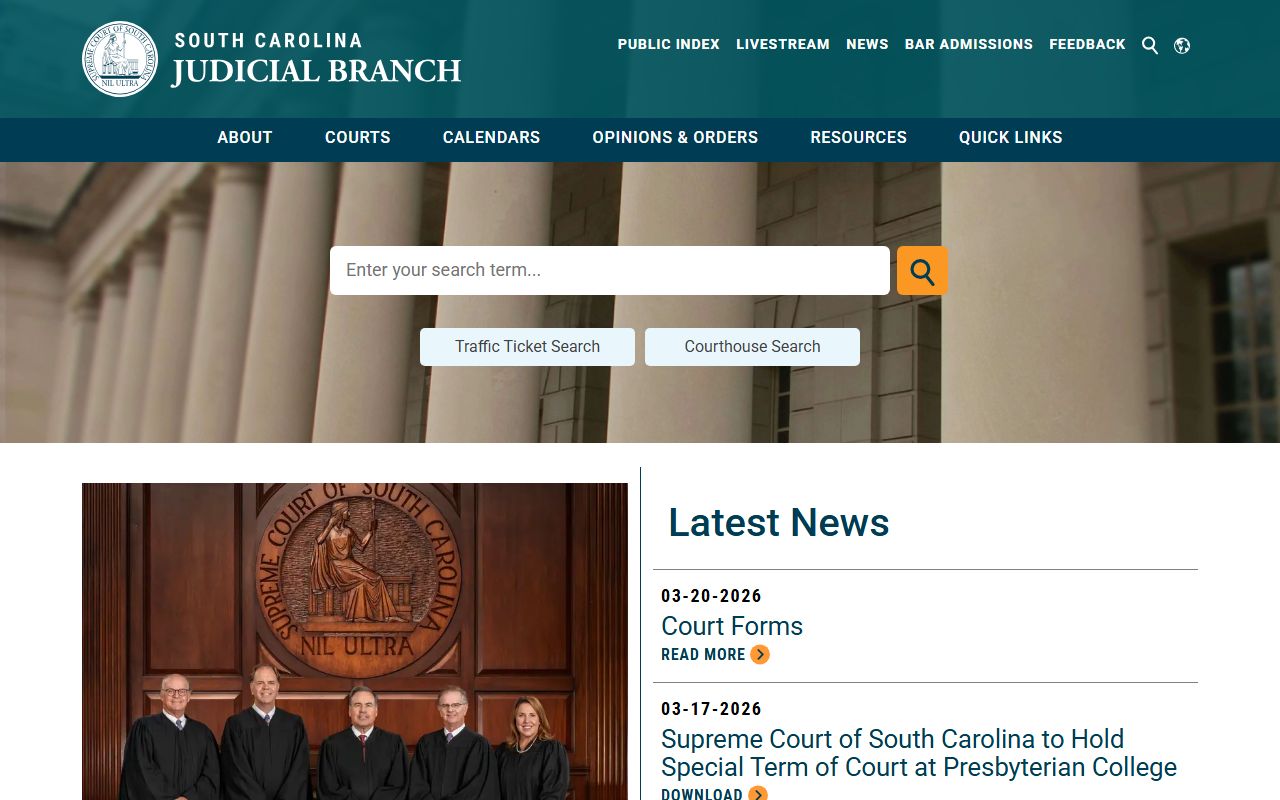
Using the portal, you can search by name and view case details without visiting the courthouse. Certified copies still require an in-person or mail request to the Clerk of Court.
Divorce Certificates in Columbia
South Carolina offers two different types of official divorce documents. The first is the divorce decree, which is the full court order signed by a Family Court judge. The Richland County Clerk of Court issues certified copies of decrees. The second is the divorce report, a shorter record kept by the SC Department of Public Health.
DPH divorce reports are available for divorces finalized between July 1962 and December 2023. Each copy costs $12. You can order through DPH directly or through VitalChek, the state's authorized third-party vendor. Reports typically show the names of the parties, the county, and the year of the divorce. They do not include property division or custody details.
For legal purposes such as remarriage or name change, you may need a certified copy of the full decree rather than just the DPH report. Check with the requesting agency to find out which document they require.
You can also request certified copies through the SC Secretary of State for apostille certification if the document will be used abroad.
Legal Help for Columbia Residents
Divorce law in South Carolina can be complex, especially in cases with children, property, or disputes over support. Columbia residents have several resources available for legal help.
SC Legal Services provides free civil legal aid to low-income residents across South Carolina. Their attorneys help with family law matters, including divorce. Eligibility is based on household income. Applications can be submitted online or by phone.
The South Carolina Bar Lawyer Referral Service can connect you with a licensed family law attorney. Call (803) 799-6653 to speak with the referral line. This service provides an initial consultation at a reduced rate.
Free court forms for divorce cases are available at sccourts.org/court-forms/. These forms are designed for use without an attorney in straightforward cases. However, if your case involves children, property, or disagreement, legal advice is strongly recommended.
Note: Law libraries are available at the Richland County Courthouse and at the University of South Carolina School of Law, which is located in Columbia.
Self-Help Divorce in Columbia
Columbia residents who have an uncontested divorce — meaning both parties agree on all terms — can often file without an attorney. This is called a pro se divorce. The SC Judicial Branch provides self-help forms online at sccourts.org/court-forms/. The packet includes the complaint, financial forms, and the final order template.
To qualify for a simplified uncontested divorce in South Carolina, both spouses must agree on property division, debt, alimony, and any child-related issues. The most common ground used in these cases is one-year separation under § 20-3-10. Both parties must sign the settlement agreement before the court will schedule a hearing.
The image below shows the Family Court information page on the SC Judicial Branch website, a useful starting point for pro se filers in Columbia.
Source: SC Judicial Branch — Family Court
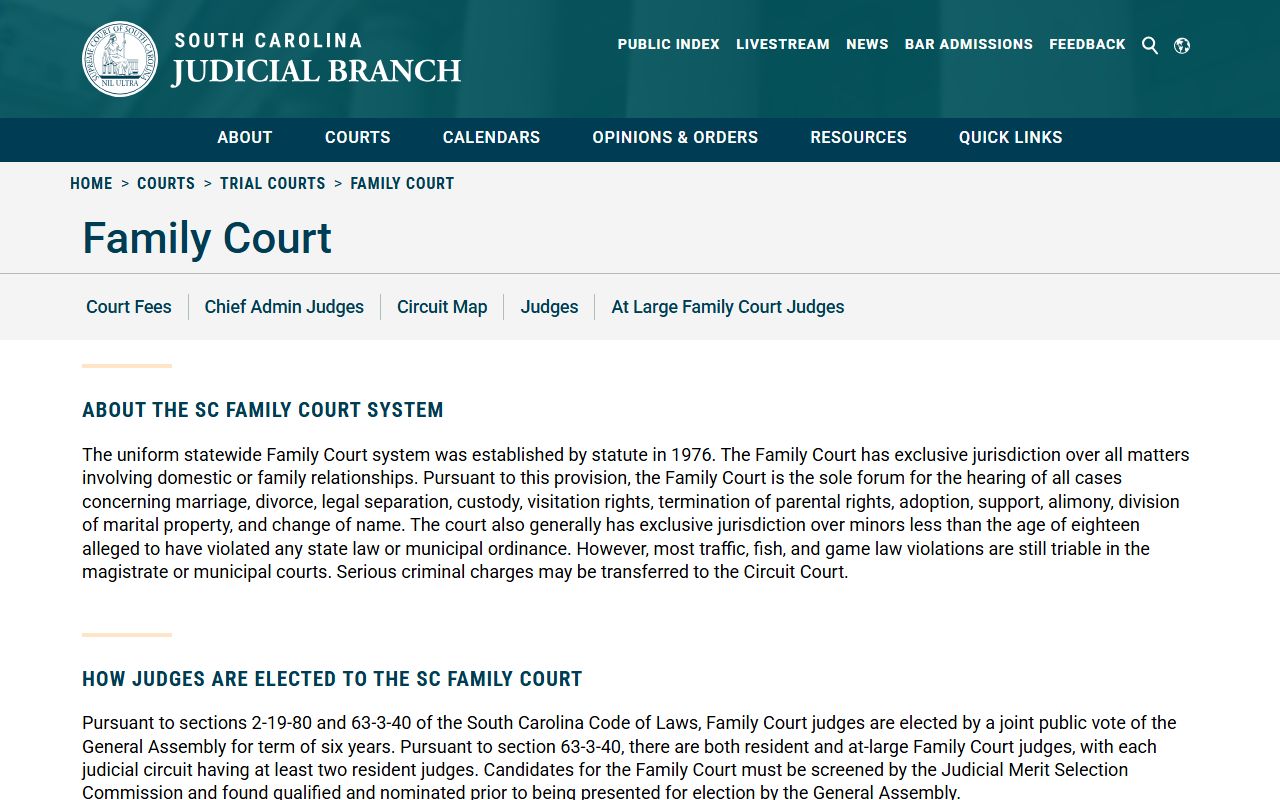
Even in an uncontested case, consider getting at least one consultation with a family law attorney. A short review can catch errors before you file and prevent costly delays later.
Richland County Divorce Records
Columbia is located in Richland County, and all divorce filings go through the Richland County Family Court. For more on the county court, full fee lists, and related records, visit the county divorce records page.
Nearby South Carolina Cities
Residents of nearby cities file for divorce at their county courthouse. Pick a city to learn about divorce records in that area.